


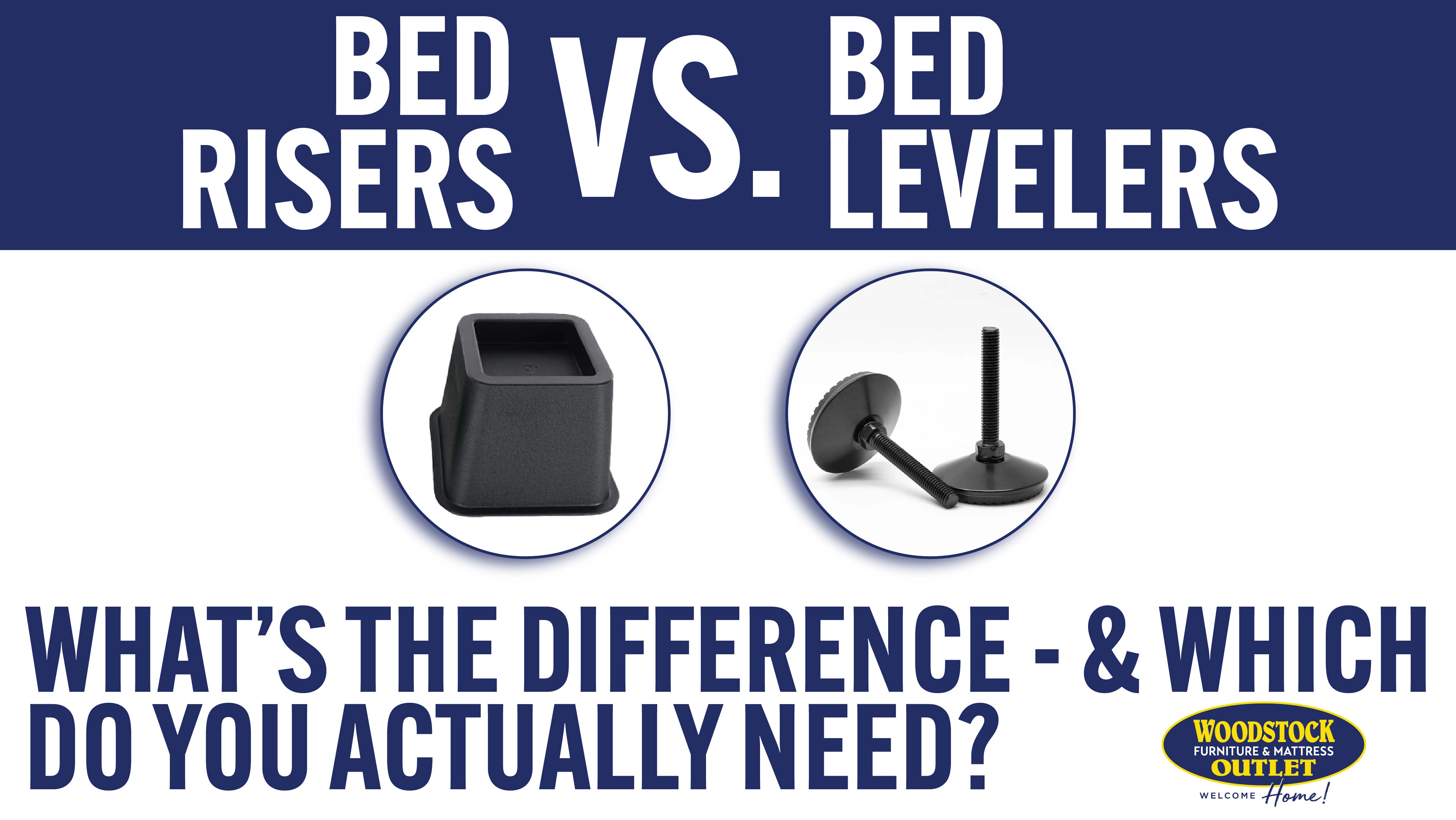
If your bed feels too low, uneven, or unstable, you’re not alone! Unfortunately, these are common issues, especially in older homes and apartments, or with older beds and bed frames. In our experience, customers most often discover these issues when moving homes, redecorating, or switching to a new mattress or bed frame.
For sleepers who may not be quite ready to buy a whole new bed, two accessories often come up in these situations — bed risers and bed levelers. While they may look similar at first glance, and do some of the same things (sort of), they’re designed to solve two very different problems. In today’s short guide, we’ll break down what each one does, discuss the ideal use case for each, and finally end with how to use bed risers and bed levelers safely.
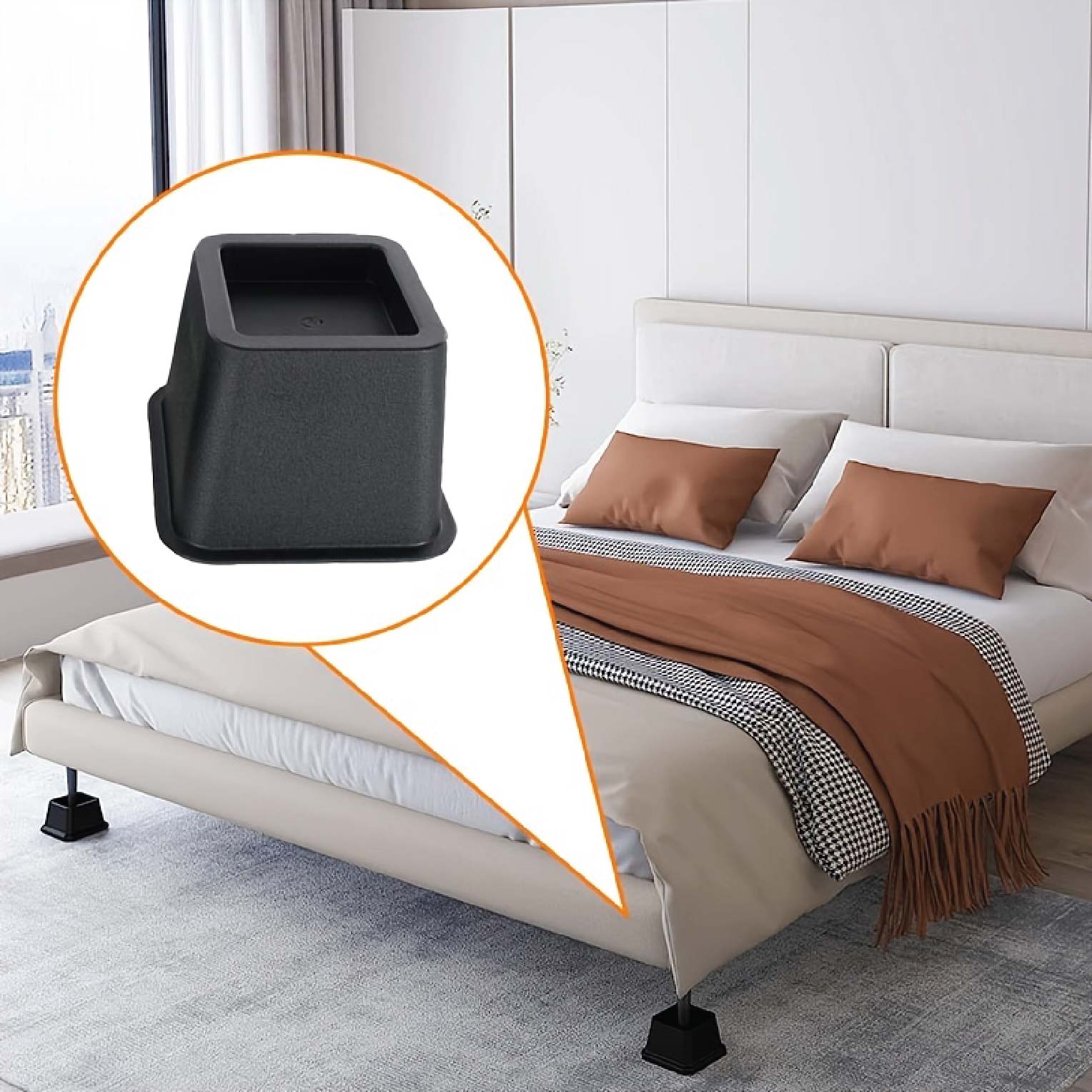
What Are Bed Risers?
Bed risers are sturdy blocks or platforms designed to lift the entire bed or bed frame higher off the floor. They typically sit underneath each bed leg or caster and raise the height by a fixed amount — most commonly 3, 5, or 8 inches.
Common Reasons People Use Bed Risers:
- The bed feels too low for you to get in and out of easily
- You want to create more space for under-bed storage
- Your bed height recently changed (for example, switching to a thicker / thinner mattress)
- For partners with differences in mobility or significant height difference, trying to better match the bed height to meet their needs
Best Use Cases for Bed Risers:
- Raising a bed to a more comfortable sitting or standing height
- Creating space for underbed storage bins, drawers, or seasonal items
- Dorm rooms, guest rooms or temporary setups
- Platform beds or metal bed frames with clearly defined legs
What bed risers don’t do well — Bed risers are not meant to correct uneven floors or fix wobbling caused by height differences between legs.
What Are Bed Levelers?
Bed levelers are adjustable devices designed to stabilize a bed and correct unevenness. Instead of adding a lot of height, they fine-tune it — usually by fractions of an inch up to about an inch or two. Some levelers screw directly into a bed frame, while others sit under the leg and allow small adjustments. Similar levelers can be found on a variety of other furniture types.

Common reasons people use bed levelers:
- The bed rocks or wobbles
- Your home’s floors are slightly sloped or uneven
- One leg doesn’t fully touch the floor as it should
- When lying down, the mattress feels like it’s not level
Best use cases for bed levelers:
- Homes with settling or uneven floors
- Adjustable or metal bed frames with threaded legs
- Situations where increasing stability is more important than adding bed height
- Minimizing leg wobble to reduce felt motion or movement in bed
What bed levelers don’t do well:
Although bed levelers can be used to raise the bed slightly, they aren’t designed to significantly raise bed height or create additional underbed storage space.
Bed Risers vs. Bed Levelers: A Simple Comparison
Feature | Bed Risers | Bed Levelers |
Primary Purpose | Raise bed height | Stabilize and level bed |
Height Added | At least several inches | Smaller, adjustable increments |
Best Use | Improving ergonomics, comfort, accessibility, or storage | Solving wobbles caused by uneven floors or legs |
Adjustability | Add height in certain fixed increments | Fully adjustable |
Can You Use Bed Risers and Levelers Together?
In some cases, yes, they can be used together. However, this must be done carefully and only under the right circumstances. When in doubt, always check with your bed’s manufacturer for product-specific guidance.
When combining them may make sense:
- You want to raise the bed and correct a slightly uneven floor
- The bed itself allows levelers to be securely attached or seated to the frame
Important considerations:
- Too much added height (whether from risers, levelers, or both) raises the bed’s center of gravity, making it feel less stable
- Most risers are not designed to work with adjustable components like levelers
- Setups that involve stacking one accessory directly on top of another are often not recommended
When stability is already a concern, it is important to solve leveling first, then decide if additional height is truly needed. If you decide you’d still like to raise the bed and if you’re in doubt about your bed’s compatibility with risers and/or levelers, it’s always best to contact the manufacturer. However, if there’s no way to level your bed frame and add the height you desire in a safe way, a new bed setup is likely the best option for you.

How to Use Bed Risers Safely
- Choose risers rated for the combined weight of the mattress, foundation / box spring, frame, and usual sleepers
- Make sure each leg sits fully inside the riser’s cup or platform
- Use risers only on solid, intact bed legs, not damaged ones
- Avoid stacking risers that aren’t designed to do so
- Avoid using mismatched risers, or risers of the wrong size or shape (e.g. round risers for round legs, square risers for square legs, etc.)
- Periodically check that everything remains secure

How to Use Bed Levelers Safely
- Match the leveler type to your bed frame (threaded vs. flat base)
- Adjust gradually — small changes can make a big difference
- Ensure all legs make firm contact with the floor
- Re-check adjustments after moving the bed or changing flooring
Which One Is Right for You?
- Choose bed risers if your main concern is significantly raising bed height (2 inches or more) and/or adding underbed storage
- Choose bed levelers if your bed feels unstable or uneven, or if you’d like to raise it only slightly (no more than 1 or 2 inches)
- Alternatively, you may want to consider a new bed setup if you’re looking to level the bed and add significant bed height at the same time — especially if you determine that there’s no way to do it safely
If you’re still unsure, start by asking a simple question — “Does my bed feel too low, or does it feel uneven?” Your answer should point you in the right direction.
Explore Your Bed Options at Woodstock Furniture & Mattress Outlet
Bed accessories like risers and levelers can be helpful tools, but neither are a one-size-fits-all solution. In some cases, bed risers or levelers may be an ideal fix. In others, the best solution may be choosing a different bed frame height, or a different mattress profile altogether. If you’d like help thinking through your setup, our team is happy to help you compare your options and figure out what fits your space best.
Regardless of which is right for your home, our goal is always to help you sleep comfortably and safely — whether that means adjusting what you have or exploring better-fitting options for your space. If you’d like help thinking through your specific setup, give us a call, drop us a line using our live web chat, or visit any of our North Georgia and Atlanta area furniture and mattress stores. We’re always happy to be a resource.
Speaking of helpful resources, don’t miss these related articles below answering frequent bed, mattress and bedroom FAQs we hear from shoppers on a regular basis:
Bed Height Guide: How Tall Should My Bed Be?
How To Raise a Bed for More Storage & Comfort
Bed Basics: Your Guide to Bed Bases, Foundations & Other Terms You Should Know
Panel Bed vs Platform Bed: What Is a Platform Bed, What Is a Panel Bed, & What’s the Difference?
Adjustable Base vs Box Spring / Mattress Foundation: Which Base Is Best for Me?